Additional Resources & Background Research
For decades, the standard medical approach to chronic tinnitus—the relentless ringing, buzzing, or whistling in the ears—has treated the condition as a localized symptom of the auditory system. Patients are routinely told to protect their hearing, use masking devices, or simply “learn to live with it.” However, an emerging convergence of modern neuroscience and historical medical philosophy suggests that millions have been looking for relief in the wrong place entirely. The true root of the phantom sounds that plague an estimated 10 to 15 percent of the global population does not originate within the mechanics of the ear, but deeper within the delicate neural pathways of the brain.
From Antiquity to the Auditory Pathway: A Historical Shift
To understand why modern medicine has spent so long focused on the ear itself, one must look at the history of otology (the study of the ear and its diseases). In ancient Egypt and Greece, phantom ear sounds were often viewed holistically. The Ebers Papyrus, an ancient Egyptian medical text dating back to roughly 1500 BCE, referred to a condition described as the “humming of the ears,” which traditional healers frequently treated with botanical formulations applied near the skull, recognizing a connection between the head’s internal balance and external symptoms.
By the 19th and 20th centuries, however, Western medicine underwent a period of extreme specialization. The human body was compartmentalized, and tinnitus was firmly relegated to the domain of the physical ear structure—specifically the cochlea and the delicate hair cells responsible for capturing sound waves. When these hair cells become damaged due to age, loud noises, or trauma, it was assumed that they simply misfired.
Yet, this localized theory has consistently failed to explain a medical paradox that has baffled surgeons for generations: when patients with severe, unidirectional tinnitus underwent surgery to completely sever the auditory nerve, the phantom ringing frequently persisted or even worsened. If the sound was being generated by a broken ear, cutting the wire to the brain should have silenced it. The fact that it did not proved that the phantom noise had already migrated, embedding itself permanently into the central nervous system.
The “Audio Input Jack” and Neural Circuitry
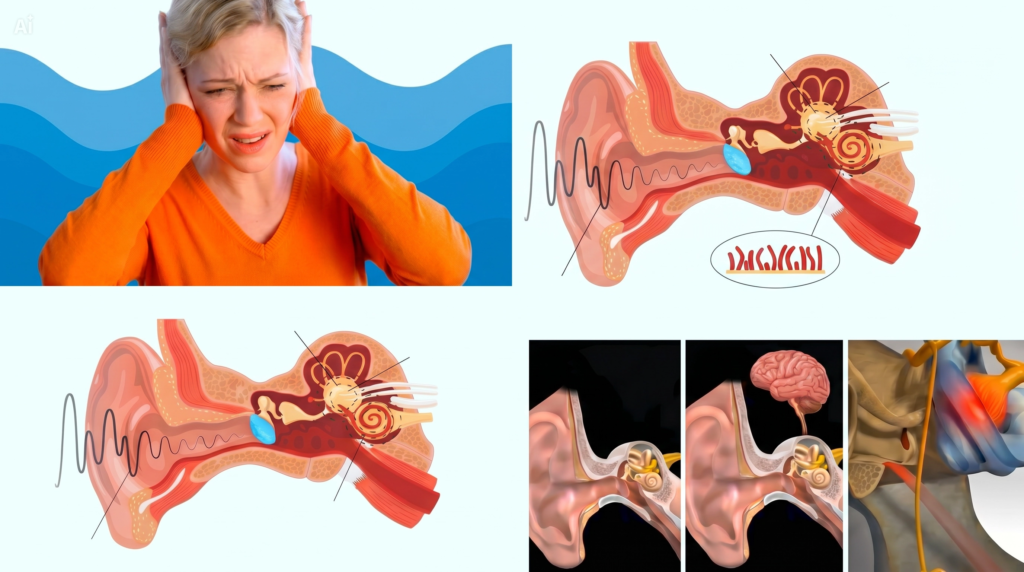
Modern neuroimaging has finally allowed researchers to look past the ear canal and map the precise terrain where tinnitus actually lives. Today, advanced auditory neuroscience views the condition not as an otological failure, but as a complex neurological phenomenon taking place within the auditory pathway—the network of nerves that transmits signals from the inner ear to the brain’s auditory cortex.
Think of this pathway as a delicate, high-fidelity electrical system. In a healthy state, the auditory nerve acts like a perfectly insulated audio cable, transmitting clear data to the brain, which then decodes those electrical impulses into recognizable sounds. However, when the neural junctions along this pathway experience degradation or structural stress, the system begins to look less like a clean wire and more like a frayed cord.
In alternative wellness and biohacking research, this phenomenon is often referred to as a compromised “audio input jack.” When the connection becomes unstable, it begins to leak chaotic, unmodulated electrical feedback. The brain’s auditory cortex, suddenly starved of the clean, structured background frequencies it expects from the physical ear, attempts to compensate. It turns up its internal volume control, amplifying the ambient neural static into a loud, piercing, and persistent phantom sound.
The Hidden Cost: Neuroinflammation and Cognitive Decline
The implications of a frayed auditory pathway extend far beyond the psychological annoyance of a constant whistle. Because the brain is a highly interconnected web, a localized electrical malfunction within the auditory cortex can trigger a cascade of systemic issues across other cognitive regions.
When the brain is forced to process chaotic feedback 24 hours a day, it enters a state of perpetual hyper-awareness. This constant neural strain frequently compromises the blood-brain barrier, leading to localized neuroinflammation—a chronic, low-grade inflammatory response within brain tissue. This explains the severe secondary symptoms that almost always accompany long-term tinnitus:
- Brain Fog and Cognitive Fatigue: The brain consumes an immense amount of metabolic energy trying to filter out the phantom noise, leaving fewer resources for analytical thinking and problem-solving.
- Insomnia and Sleep Disturbances: The hyperactivity of the auditory pathway keeps the central nervous system stuck in a sympathetic “fight-or-flight” loop, preventing the deep, restorative delta-wave sleep necessary for brain cellular repair.
- Memory Slips: Chronic neuroinflammation can degrade healthy brain cells over time, particularly within the hippocampus, the region responsible for memory consolidation.
Restoring the Neural Junction: A Natural Approach to Calm
If the root cause of the ringing is a compromised neural connection rather than a broken ear, then traditional solutions aimed solely at external hearing amplification are merely masking a deeper issue. True relief requires a fundamental shift toward supporting neuroplasticity—the brain’s natural ability to reorganize, repair, and stabilize its neural pathways.
A holistic approach to addressing an unstable auditory pathway involves targeting the “neural junctions” directly. Botanical formulations rich in natural neuroprotective compounds and specific antioxidants have long been utilized in traditional wellness systems to soothe inflamed nerve tissue, improve cerebral blood circulation, and protect delicate neural cells from further oxidative stress. Additionally, wellness protocols that promote deep relaxation and alpha-wave brainwave states can help the central nervous system “turn down the gain” on its internal amplifier, encouraging the auditory cortex to return to a state of quiet, balanced baseline function.
The science is clear: to silence the noise, we must stop treating the ears and start feeding the brain. By shifting the focus toward neural structural repair and systemic inflammation reduction, it is entirely possible to restore clear communication to the auditory pathway, reclaim sharp mental focus, and finally experience the profound relief of true, uncompromised silence.