
WARNING: Mainstream medicine tells you an enlarged prostate is just a “normal part of getting older.” They are wrong. Watch the short presentation below to discover the exact mineral trigger harming your urinary system…
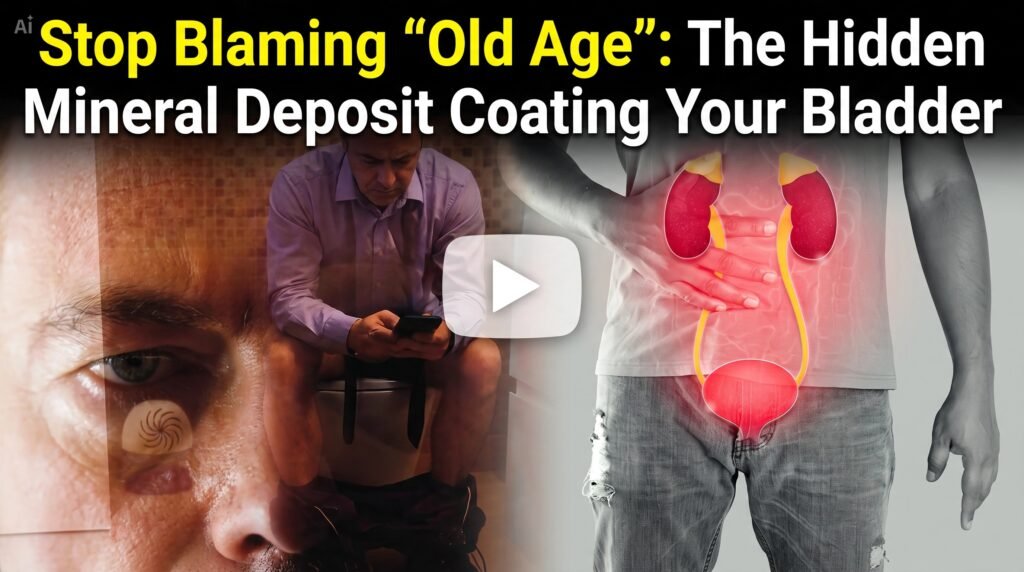
The “Normal Aging” Lie Exposed: Why doctors blame your age for prostate growth, and the breakthrough Harvard study proving a hidden mineral buildup is the real culprit harassing your bladder.
The Silent “Limestone” Threat: How microscopic mineral deposits coat your urinary walls and trap toxic gunk, creating constant, painful pressure on your urethra.
The “Flushing” Method Big Pharma Ignores: The simple home protocol that targets trapped mineral gunk to restore a strong, steady stream—without risky procedures or lifelong prescriptions.
The Kidney & Bladder Domino Effect: Why ignoring urinary pressure risks severe complications like bladder stones and infections, and how clearing this single blockage supports total urinary system health.
Reclaiming Youthful Vitality: How dissolving toxic buildup frees you from embarrassing bathroom leaks, constant anxiety, and lost stamina—no matter if you are 40, 70, or 80 years old.
Access the full breakdown by clicking to play the video above or clicking the button below.
Additional Resources & Background Research
Stop Blaming “Old Age”: The Hidden Mineral Deposit Coating Your Bladder Right Now (And How to Dissolve It Naturally)
For generations, the gradual decline of urinary function in aging men was accepted as an inevitable biological tax. Frequent nighttime disruptions, reduced flow velocity, and persistent pelvic discomfort were historically chalked up to the simple wear-and-tear of time. However, modern integrative research and historical medical archives reveal a far more complex picture. The primary driver of lower urinary tract distress is often not merely the passage of time, but the progressive accumulation of calcified mineral deposits within the bladder and prostate micro-vasculature.
Understanding how these mineral crusts form—and how classical botanical traditions sought to break them down—offers a fresh, scientific perspective on men’s longevity and physiological self-sufficiency.
1. The Historical Context: How Traditional Medicine Viewed Calcification
Long before the advent of modern diagnostic imaging, physicians across antiquity observed a distinct difference between organic tissue enlargement and mineralized obstruction. Ancient Greek practitioners, including Galen, wrote extensively on the concept of calculi—stony accretions that formed when bodily fluids became stagnated or chemically imbalanced.
In the 19th and early 20th centuries, as clinical pathology advanced, researchers noted that chronic low-grade inflammation within soft tissues frequently acted as a magnet for ionized minerals. When mucosal linings undergo prolonged irritation, the body’s local pH balance shifts toward alkalinity. This alkaline micro-environment creates optimal conditions for calcium salts, phosphates, and carbonates to precipitate out of the urine and blood. Rather than floating freely, these microscopic crystals adhere to the soft vascular walls of the prostate gland and the smooth lining of the bladder.
2. The Science of the “Limestone” Coating: How Deposits Form
To understand how mineral deposits compromise urinary function, one must look at the cellular interplay between mineral homeostasis and tissue inflammation.
- Precipitation and Biomineralization: The human urinary tract is continuously processing a dense mixture of dissolved minerals. Under healthy conditions, specialized proteins inhibit these minerals from binding together. However, when local blood flow decreases or cellular debris accumulates, dissolved calcium ions bind with circulating phosphates and carbonates, forming microscopic, limestone-like crusts along tissue walls.
- Urethral Compression and Mechanical Stress: As these micro-calcifications build up inside the prostate tissue and bladder lining, they diminish tissue elasticity. The prostate loses its natural flexibility, putting direct mechanical pressure on the urethra. This pressure restricts the urinary exit path, leading to the classic symptoms of hesitant flow and incomplete emptying.
- Biofilm and Toxic Entrapment: Beyond mechanical pressure, these mineral matrices provide an ideal structural scaffolding for microscopic cellular waste and bacterial biofilms. The mineral shell protects trapped organic debris from being naturally flushed out by the body’s immune defenses, creating a cycle of persistent, low-grade irritation.
3. Breaking the Matrix: The Physiology of Natural Dissolution
Reversing biomineralization requires a two-pronged physiological strategy: altering the local chemical environment to solubilize calcium deposits, and restoring smooth muscle flexibility.
Throughout history, herbalists and botanical chemists relied on specific plant compounds known as lithotriptics (from the Greek words for “stone” and “breaking”). Modern phytochemical analysis shows that these botanicals function through sophisticated biochemical pathways rather than crude mechanical breakdown.
Chelating Agents and Calcium Mobilization
Certain plant polyphenols and organic acids act as natural chelators. At a molecular level, chelating molecules possess chemical bonds that wrap around free metallic ions, such as calcium (Ca2+). By binding to these ions, natural chelating agents help soften the outer layers of calcified deposits, allowing the body’s lymphatic system to transport them away.
Regulating Calcium Transport (Vitamin Mechanics)
Proper mineral distribution relies heavily on fat-soluble cofactors. Fat-soluble nutrients like Vitamin K2 (specifically the menaquinone-7 matrix) direct matrix Gla-protein (MGP), an active inhibitor of soft-tissue calcification. MGP acts as a biological traffic cop: it prevents calcium from settling into blood vessels and soft prostatic tissue, ensuring it remains bound within bones and teeth where it belongs.
Restoring Urinary Flow via Smooth Muscle Relaxation
In addition to mineral clearance, relieving urethral compression requires relaxing the surrounding smooth muscle tissues. Specific botanical extracts contain bioflavonoids that modulate nitric oxide production in endothelial cells. Higher nitric oxide levels encourage smooth muscle relaxation around the bladder neck, improving flow rate while the underlying mineral matrix is systematically cleared.
4. Long-Term Prevention and Urinary Self-Sufficiency
Overcoming the false narrative that urinary decay is a mandatory part of aging is the first step toward lifelong vitality. While acute medical interventions remain vital for advanced conditions, incorporating foundational wellness practices helps prevent mineral precipitation before it begins:
- Optimal Hydration Dynamics: Maintaining low urinary solute concentrations prevents dissolved minerals from reaching their saturation threshold.
- pH Balance Maintenance: Diets rich in bioavailable antioxidants and organic acids assist in keeping urinary pH within a range that resists calcium crystallization.
- Targeted Botanical Support: Historically recognized lithotriptic herbs and mineral-regulating nutrients provide continuous defense against micro-calcification buildup.
By addressing the root mechanism of calcification rather than merely masking symptoms, men can protect their urinary sovereignty, restore sleep quality, and maintain physical vigor well into their later years.