
What mainstream medical sources ignore could cost you your independence. Pay close attention the short video before it’s taken down…
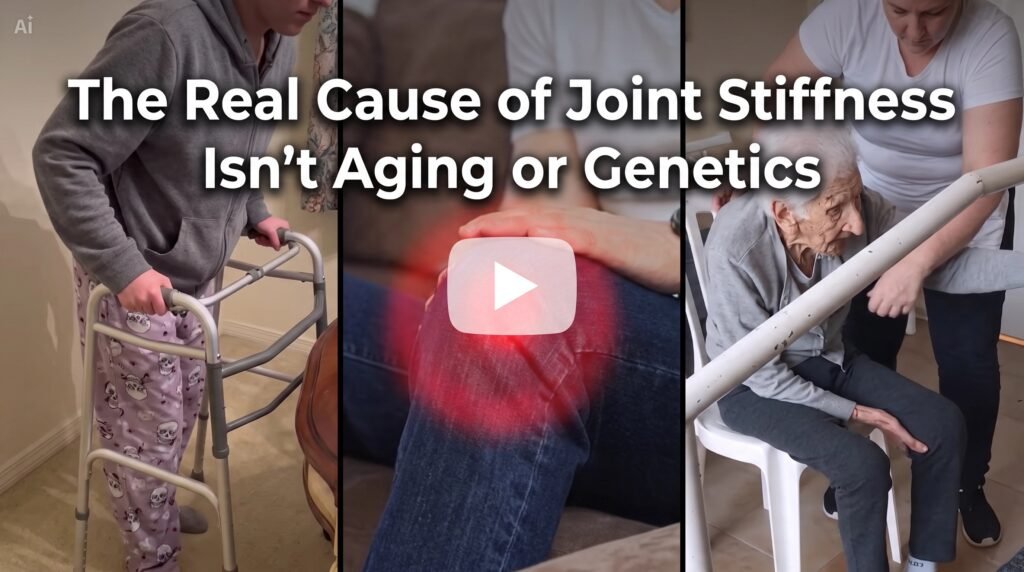
- The “Normal Aging” Lie: Why doctors dismiss cracking knees and morning stiffness as “just getting older”—and how this dangerous myth causes millions to suffer permanent mobility loss.
- The Harvard Breakthrough: The shocking “silent mechanism” destroying your joint cartilage from the inside out (Hint: It has nothing to do with genetics or wear-and-tear).
- The Silent Joint Saboteur: Why conventional pain-relief routines actually backfire, accelerating joint deterioration while masking the real problem.
- The 20-Something Mobility Secret: The simple, natural discovery that targets the true root cause of chronic joint decay so you can squat, climb stairs, and move effortlessly again.
- Access the full breakdown by clicking to play the video above or clicking the button below.
Additional Resources & Background Research
Harvard Study Reveals: The Real Cause of Joint Stiffness Isn’t Aging or Genetics—It’s Something Far More Dangerous Happening Inside Your Joints Right Now
For thousands of years, human civilizations have sought to understand why fluid youth inevitably yields to stiff, aching joints. Ancient Egyptian medical papyri from 1500 BCE recorded treatments using animal fats and plant ointments to soothe rigid limbs, while early Greco-Roman physicians viewed joint distress simply as the inevitable drying out of vital bodily humors. When Sir Archibald Garrod officially coined the term osteoarthritis in 1890, it cemented a long-held medical paradigm: joint degradation was merely a mechanical tax imposed by time and gravity.
For over a century, mainstream medicine treated human joints like mechanical gears on an ungreased bicycle—blaming decades of friction, chronological age, and genetic luck. However, landmark research led by investigators at Harvard Medical School has shattered this outdated framework. Scientists discovered that joint stiffness is not an unavoidable consequence of getting older, nor is it purely dictated by DNA. Instead, it is driven by a hidden, self-perpetuating biological mechanism operating deep within the cellular scaffolding of cartilage.
Beyond “Wear and Tear”: The Historical Misconception of Joint Degradation
The human joint is a remarkable biological engineering marvel. Where two bones meet, they are capped by smooth articular cartilage—a slippery, rubbery connective tissue that allows friction-free movement while absorbing shock. Suspended within this cartilage is a dense structural network known as the extracellular matrix (ECM), surrounded by specialized cells called chondrocytes that maintain and repair the joint.
In early 20th-century orthopedics, joint pain was classified almost exclusively through radiographic evidence of bone spurs and narrowed joint spaces. The prevailing assumption was that cartilage simply “wore down” like tire tread after thousands of miles. This passive view led to decades of palliative strategies focused primarily on numbing pain signals rather than addressing the tissue environment itself.
Modern molecular biology, however, paints a far more dynamic—and concerning—picture. Cartilage does not merely rub away; it actively degrades when its internal biochemical communication breaks down.
The Silent Molecular Trap: Extracellular Matrix Stiffening and Klotho Repression
The breakthrough from Harvard researchers highlights a precise biological cascade: age-related and mechanical changes cause the extracellular matrix surrounding cartilage cells to become unnaturally rigid. Far from being a passive structural backdrop, the ECM actively communicates with chondrocytes through a process known as mechanotransduction—where cells read physical forces in their environment and alter their genetic behavior accordingly.
When the matrix hardens, it sends altered mechanical signals to the chondrocytes. This increased stiffness induces epigenetic changes—altering how DNA is organized and read—which represses the production of a critical longevity protein called Klotho ($\alpha$-Klotho).
Klotho acts as a master protector of cellular health, safeguarding cellular powerhouses (mitochondria) and preventing premature tissue breakdown. When matrix stiffening suppresses Klotho, chondrocytes lose their ability to maintain cartilage integrity. Strikingly, researchers observed that even youthful chondrocyte cells placed into a rigid matrix quickly took on the characteristics of aged, dysfunctional cells. Conversely, when aged cartilage cells were exposed to a softer, compliant matrix environment, their healthy cellular function was restored.
This discovery proves that joint stiffness is not an irreversible fate written into your birth date; it is driven by a reversible environment of mechanical and molecular stress.
[ Hardened Extracellular Matrix ]
               │
               ▼  (Epigenetic Repression)
    [ Suppressed Klotho Protein ]
               │
               ▼
[ Impaired Chondrocytes & Cartilage Decay ]
Low-Grade Inflammation and the Escalating Degradation Cascade
When Klotho levels drop due to matrix stiffening, a cascade of cellular decay takes hold. Starved of protective signaling, chondrocytes begin releasing catabolic enzymes—specifically matrix metalloproteinases (MMPs)—that break down collagen and proteoglycans from within.
This structural decay releases microscopic tissue fragments into the joint cavity. The immune system misinterprets these fragments as foreign threats, triggering a continuous, low-grade inflammatory response within the synovial membrane. Unlike the acute, visible swelling seen in severe trauma, this subtle, chronic micro-inflammation operates silently for years. It further accelerates matrix hardening, shuts down natural tissue repair, and sensitizes local nerve endings, turning routine movements into sources of sharp discomfort.
Left unchecked, this feedback loop transforms mild morning stiffness into systemic mobility loss. Because traditional over-the-counter pain relievers only interrupt pain signals at the nerve level, they leave this destructive matrix-stiffening loop completely untouched.
Reclaiming Joint Dynamics: The New Frontier in Integrative Musculoskeletal Health
Understanding joint health through the lens of matrix dynamics shifts the focus from temporary symptom management to comprehensive micro-environmental support. Rather than accepting joint stiffness as an inevitable burden of time, holistic researchers focus on key physiological objectives:
- Preserving Matrix Elasticity: Supporting systemic connective tissue flexibility to prevent the physical hardening that represses protective proteins like Klotho.
- Modulating Micro-Inflammation: Neutralizing the enzymatic and inflammatory cascades that break down structural cartilage matrix components.
- Protecting Chondrocyte Viability: Maintaining cellular energy production and mitochondrial integrity so cartilage cells can actively repair daily micro-wear.
- Optimizing Synovial Fluid Quality: Ensuring joint cavities remain lubricated with high-viscosity biological fluid to dampen harsh mechanical forces.
As medical history demonstrates, true breakthroughs occur when we stop treating symptoms and start addressing root biological mechanisms. By prioritizing matrix compliance, cellular protection, and balanced micro-inflammation, it becomes possible to safeguard joint independence and maintain effortless mobility across every decade of life.